
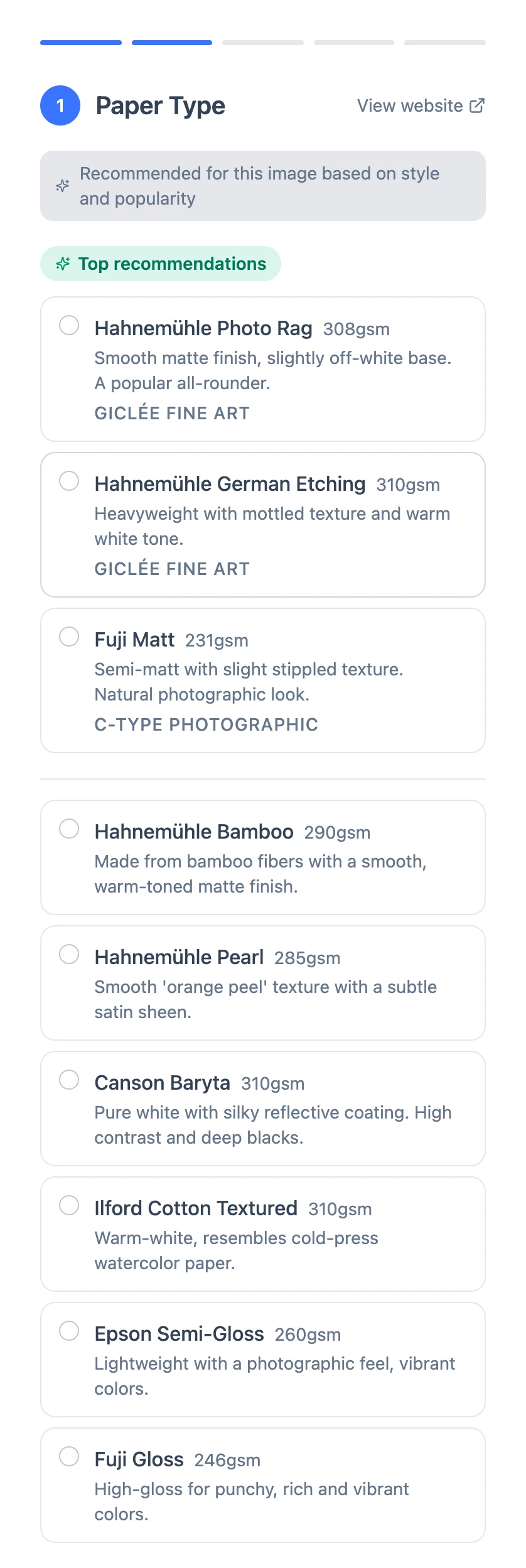
Our papers weigh between 231gsm and 310gsm. Hahnemühle Photo Rag 308gsm, the most popular, is 0.48 mm thick. Mounting substrates run from 2 mm Display Card to 12 mm MDF, and Dibond is 3 mm.
Paper weights and surfaces
| Paper | Print type | Weight | Surface |
|---|---|---|---|
| Hahnemühle Photo Rag | Giclée | 308gsm | Smooth matt, 100% cotton, no visible texture |
| Hahnemühle German Etching | Giclée | 310gsm | Matt with a pronounced, mottled texture |
| Ilford Cotton Textured | Giclée | 310gsm | Matt, tighter texture like cold-press watercolour paper |
| Canson Baryta | Giclée | 310gsm | Light gloss, silky reflective coating |
| Hahnemühle Bamboo | Giclée | 290gsm | Smooth matt, 90% bamboo fiber and 10% cotton |
| Hahnemühle Pearl | Giclée | 285gsm | Satin sheen with a fine orange peel texture |
| Epson Semi-Gloss | Giclée | 260gsm | Slight gloss, resin-coated, photographic feel |
| Fuji Gloss | C-type | 246gsm | Gloss photographic paper |
| Fuji Matt | C-type | 231gsm | Semi-matt with a slight sheen and a fine stippled texture |
The heavier papers (308 to 310gsm) feel more substantial in the hand. The lighter ones (231 to 260gsm) are still archival but feel more photographic. For help choosing between them, see how to choose a print and paper type.
Base tone, from warmest to brightest
- Hahnemühle Bamboo: the warmest base, a warm creamy yellow.
- Ilford Cotton Textured: warm white.
- Hahnemühle German Etching: slightly warm white.
- Hahnemühle Photo Rag: off white.
- Canson Baryta and Epson Semi-Gloss: the brightest whites.
Weights we don't stock
- Our heaviest papers are 310gsm. We don't carry a 350gsm paper, or 400 to 600gsm board or card stock.
- We don't stock lightweight poster paper of around 90gsm.
- There is no dedicated card stock, though the heavier fine art papers may give a similar feel.
Paper thickness
Hahnemühle Photo Rag 308gsm is 0.48 mm thick. If you need the thickness of another paper, tell us which paper and what you are building through the contact page and we will get the exact specification for you. For a large or repeat order, ask before you commit so the measurements can be designed in from the start.
Mounting substrate thickness
| Substrate | Thickness |
|---|---|
| Display Card | 2 mm |
| Dibond (aluminum composite panel) | 3 mm |
| Foamex | 3 mm or 5 mm |
| Foam Board | 5 mm |
| MDF | 12 mm |
A Photo Rag 308gsm print mounted on Dibond is approximately 3.48 to 4 mm thick overall. The range allows for the adhesive layer and normal variation in mounting, so for a tight tolerance work to the upper figure and leave a little headroom. Mounting options are on the mounting page.
Working out a stack height for an album or box
- Take the single-sheet thickness of the paper.
- Multiply by the number of sheets. Fifty sheets of a 0.48 mm paper come to roughly 24 mm.
- Add a few millimetres of tolerance. A stack of prints rarely compresses to the exact mathematical total.
- If the prints are mounted on Dibond, add 3 mm per print.
Surface durability and handling
- Delicate surfaces: German Etching, Bamboo and Canson Baryta.
- Medium: Ilford Cotton Textured and Epson Semi-Gloss.
- High: Hahnemühle Pearl, which is also a good choice for mounting.
The matt cotton papers are uncoated, which makes them more delicate in mounting than the coated, resin-based papers. If you mount Canson Baryta, add a white border to protect image detail at the edges of the print.
For prints hung unframed with clips, the 308 to 310gsm papers hold their shape best. Prints that will be handled regularly are better mounted to Foamex or Dibond.
If you plan to paint over the print
Our papers are fine art printing papers, not papers sized for wet media, and we don't offer a watercolour-specific paper.
- Hahnemühle Photo Rag 308gsm is 100% cotton and acid-free with a smooth matt surface, and suits painting over with acrylics. The acrylic sits on top of the surface; it does not absorb as it would on a traditional painting paper.
- Hahnemühle German Etching 310gsm has more tooth and suits heavier paint layers.
- With watercolour or heavily diluted paint, keep washes light. Printing papers are not designed for heavy water loads and may buckle.
Every paint and medium behaves differently on a print surface, so order a test strip on your chosen paper and try your paint on it first.
Seeing and feeling the papers
Order a sample pack of A4 prints across the paper range, or a 4" x 30" test strip of your own image on each paper you are considering. The paper name is printed along the edge of each test strip, so you can tell them apart.
For how these substrates look and hang, see our photo and art mounting page, which shows the materials with fixtures such as subframes and battens.